
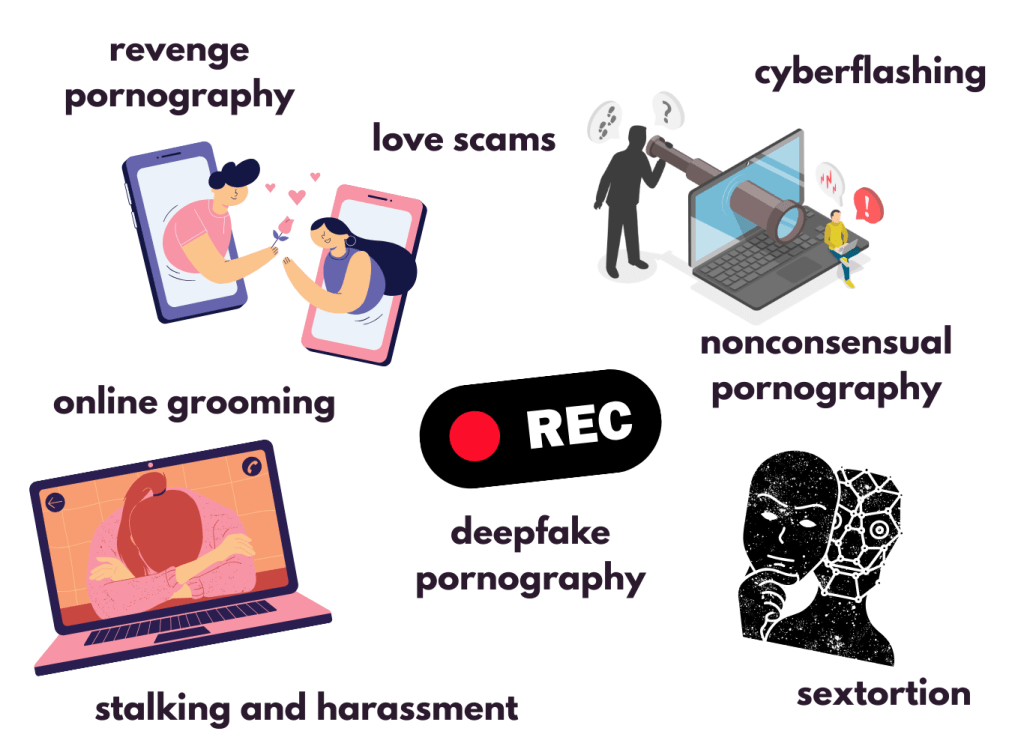
Did you come across a term you don’t recognize? Do you want to find the right way to describe an experience? Our Online Sexual Harms Glossary is here to help! If you’d like to request the addition of a term/definition, please contact us.
A | B | C | D | E | F | G | H | I | J | K | L | M | N | O | P | Q | R | S | T | U | V | W | X | Y | Z
C
Cyberflashing: the act of sending unwanted sexual images, videos, or audios to another person digitally, often using Bluetooth, AirDop, or other file-sharing services.
Cyberstalking or online stalking: the use of digital technologies to repeatedly track, watch, intrude upon, or harass someone, causing discomfort, fear, or distress.
D
Deepfake pornography: sexual or intimate images, videos, or audios that were generated (algorithmically synthesized) or manipulated using artificial intelligence (AI) to make it appear that someone did or said something that they did not.
While this term is popular, it is problematic and should be avoided. By framing this form of violence as “pornography,” we implicitly legitimize the consumption of abuse material as a form of erotic entertainment. Better terms to describe AI-generated sexual imagery include “deepfake nudes” or “deepfake sexual abuse material.”
Doxxing: the act of non-consensually sharing someone else’s personal or identifying information online, especially with the intent to harass, humiliate, or distress.
I
Image-based sexual abuse (IBSA): nonconsensual creating, taking, or sharing of sexual or intimate images or videos, including threatening these actions.
Intimate content: images, videos, audio, writing, or other artifacts that depict someone nude, partially nude, engaging in a sexual act or position, using the toilet, or otherwise revealing something ordinarily private.
This can be culturally relative. For instance, a depiction of someone without their religious head covering could constitute an intimate image, especially if the depicted person feels their privacy or bodily autonomy has been violated.
Intimate image abuse: nonconsensual creating, taking, or sharing of sexual or intimate images or videos, including threatening these actions.
L
Love scam or online romance scam: fraud where perpetrators fabricate an online romantic relationship to emotionally manipulate and financially exploit someone.
N
Nonconsensual pornography: sexual or intimate media produced, obtained, or distributed without the clear, willing agreement of all people involved.
While this term is popular, it is problematic and should be avoided. By framing this form of violence as “pornography,” we implicitly legitimize the consumption of abuse material as a form of erotic entertainment. Better terms to describe non-consensually distributed media include “image based sexual abuse (IBSA) material” and “non-consensual intimate imagery (NCII)”
Non-consensual intimate image (NCII) abuse: nonconsensual creating, taking, or sharing of sexual or intimate images or videos, including threatening these actions.
O
Online sexual grooming: the act of building an online relationship with a minor or vulnerable adult through manipulation with the intent of sexual abuse or exploitation.
R
Revenge pornography: sexual or intimate media distributed non-consensually, typically by a former partner with the intention of humiliating or harming the depicted person.
While this term is popular, it is problematic and should be avoided. By framing this form of violence as “revenge,” we imply that there was some initial wrongdoing by the victim that provoked this action and privilege the perpetrators’ perspective. This is victim blaming and is not survivor-centric. By framing this form of violence as “pornography,” we implicitly legitimize the consumption of abuse material as a form of erotic entertainment. Better terms to describe non-consensually distributed media include “image-based sexual abuse (IBSA),” “IBSA material,” and “non-consensual intimate image (NCII) abuse,” “NCII sharing.”
S
Sexual coercion: the use pressure, manipulation, or other non-physical force to persuade someone into unwanted sexual activity.
Sexual harassment: unwanted sexual behavior or attention, including sensitive language, gestures, or touching, that makes someone feel offended, humiliated, or intimidated.
Sextortion or sexual extortion: a form of blackmail where the perpetrator threatens to sexual or intimate images or videos to coerce someone into complying with certain financial or behavioral demands.
T
Technology-facilitated sexual violence (TFSV): any act of sexual violence enabled or facilitated by digital technologies whether occurring online or face-to-face.
U
Upskirting: the act of taking a nonconsensual photo or video underneath someone’s clothing, typically of their genital area.
V
Voyeurism: the intentional and clandestine observation, including by recording, of others engaging in an private, especially intimate or sexual, acts.
Click here to see how voyeurism is defined by Singapore law under Penal Code 1871 Section 377BB.
Some kink communities use the terms “voyeurism” and “exhibitionism” to refer to consensual practices. In our discussion of online sexual harms, when we use the term “voyeurism” we emphasize that any observation or recording occurring without the permission of the observed party is a form of sexual harm.
 Online Sexual Harms in Singapore